Pearson Edexcel · GCSE · English Literature
Shakespeare and Post-1914 Literature
Component 1 challenges you to engage critically with some of the greatest works in English Literature: Shakespeare's enduring drama and thought-provoking Post-1914 texts. Studying this paper is incredibly rewarding as it sharpens your analytical skills, deepens your understanding of human nature across different eras, and helps you construct sophisticated, evidence-based arguments.
- 4 min read
- 2 worked examples
- 4 practice questions
- 8 key terms
Study Notes
Overview
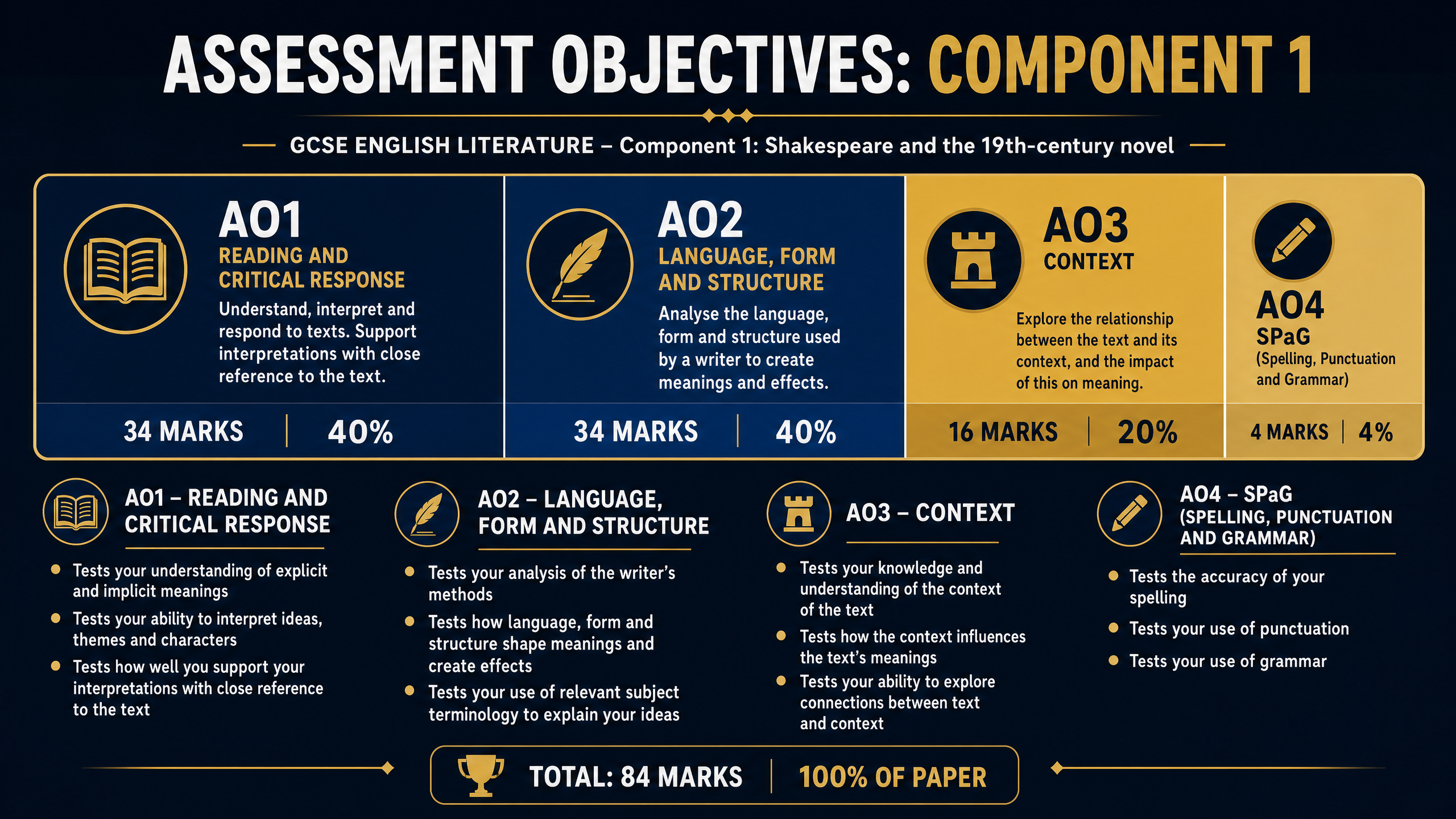
Component 1: Shakespeare and Post-1914 Literature is a demanding but highly rewarding closed-book examination that constitutes 50% of your GCSE English Literature grade. Examiners are looking for candidates who can offer a conceptualised, personal response to texts, rather than simply retelling the plot. You must demonstrate a secure understanding of how writers use language, form, and structure to create meaning (AO2), and how the texts are shaped by their historical and social contexts (AO3). The ability to embed quotations seamlessly and construct a coherent argument using accurate terminology is essential for reaching the top bands.
Listen to the comprehensive revision podcast here:

Examination Structure
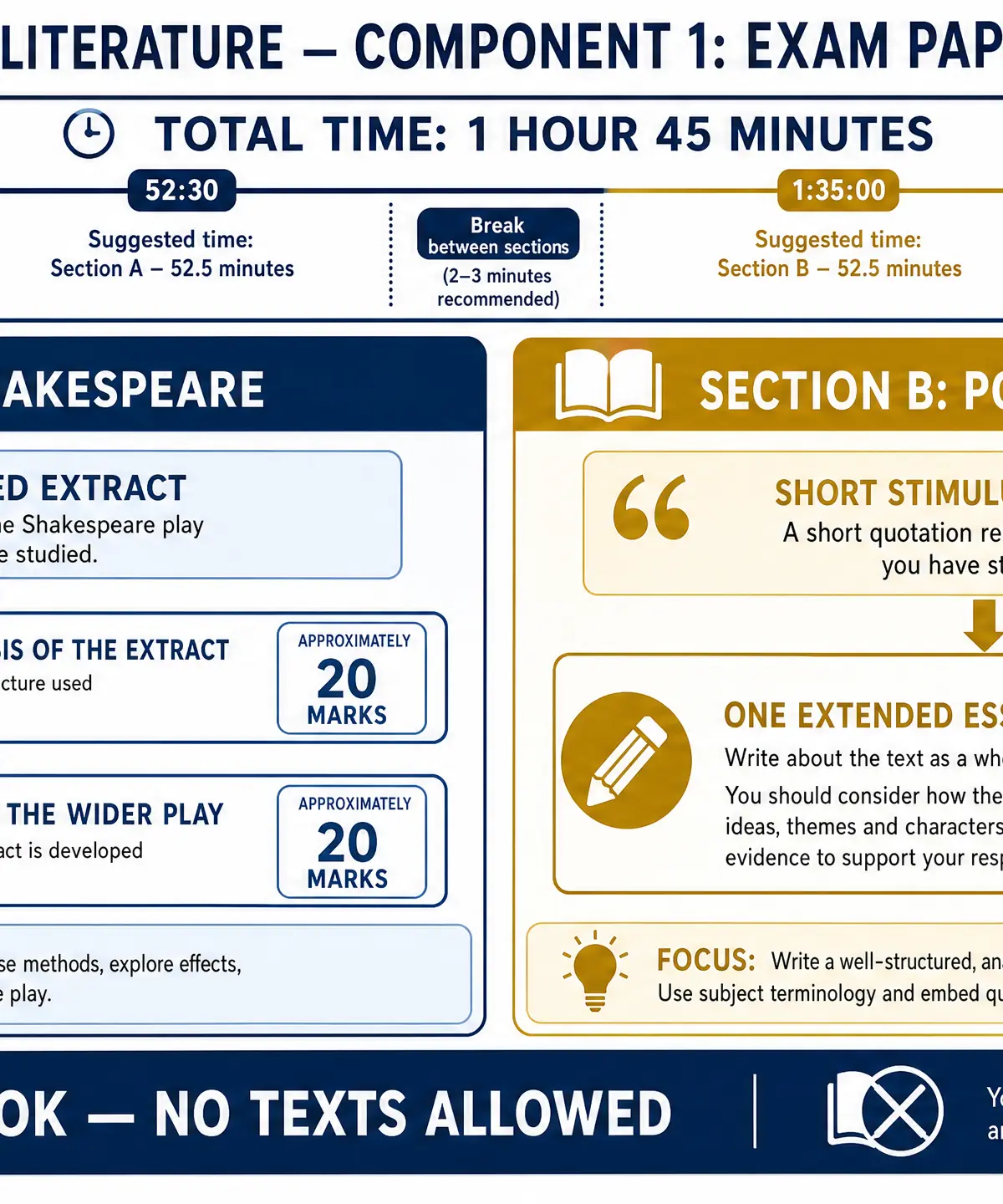
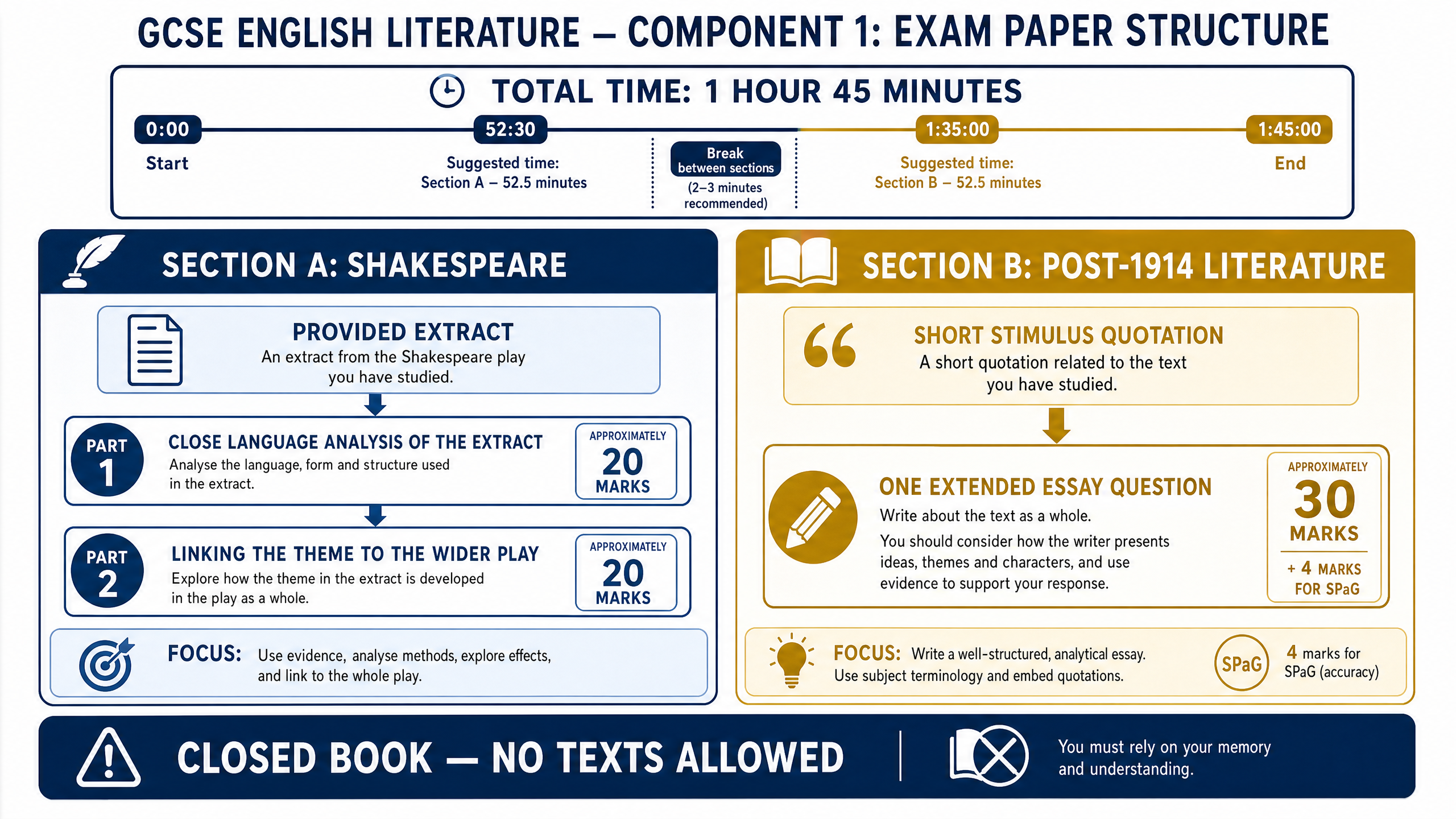
The 1 hour 45 minute paper is split into two sections. Section A focuses on your Shakespeare play, requiring a close analysis of a provided extract (Part 1) followed by an exploration of how a theme from that extract is developed across the wider play (Part 2). Section B focuses on your Post-1914 text, where you must write one extended essay based on a short stimulus quotation. Time management is critical: you should aim for approximately 52 minutes per section.
Assessment Objectives (AOs)
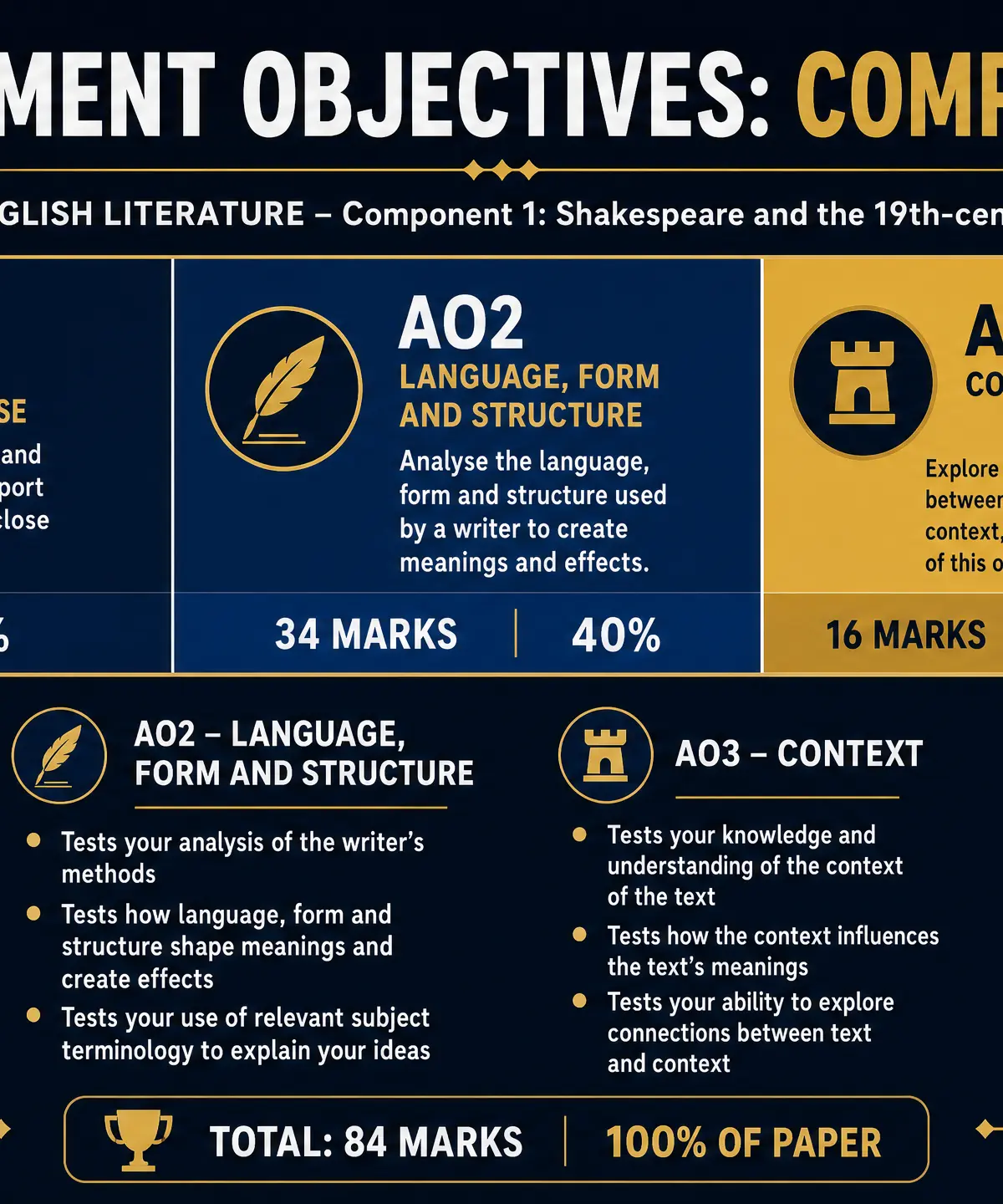
To succeed, you must understand exactly what you are being marked on:
- AO1 (Reading and Critical Response): Tests your ability to interpret texts and support your ideas with embedded quotations.
- AO2 (Language, Form and Structure): Tests your analysis of the writer's methods. This is where you explore how meaning is created.
- AO3 (Context): Tests your understanding of the relationship between the text and the era in which it was written.
- AO4 (SPaG): Tests spelling, punctuation, and grammar (assessed in Section B only).
Writer's Methods (AO2 Focus)
Examiners consistently note that the best responses focus heavily on the writer's craft. When analysing Shakespeare, you must consider his use of dramatic form—soliloquies to reveal inner turmoil, dramatic irony to build tension, and verse versus prose to indicate status or state of mind. For Post-1914 texts, consider narrative perspective, staging (if it's a play like An Inspector Calls), and structural shifts.
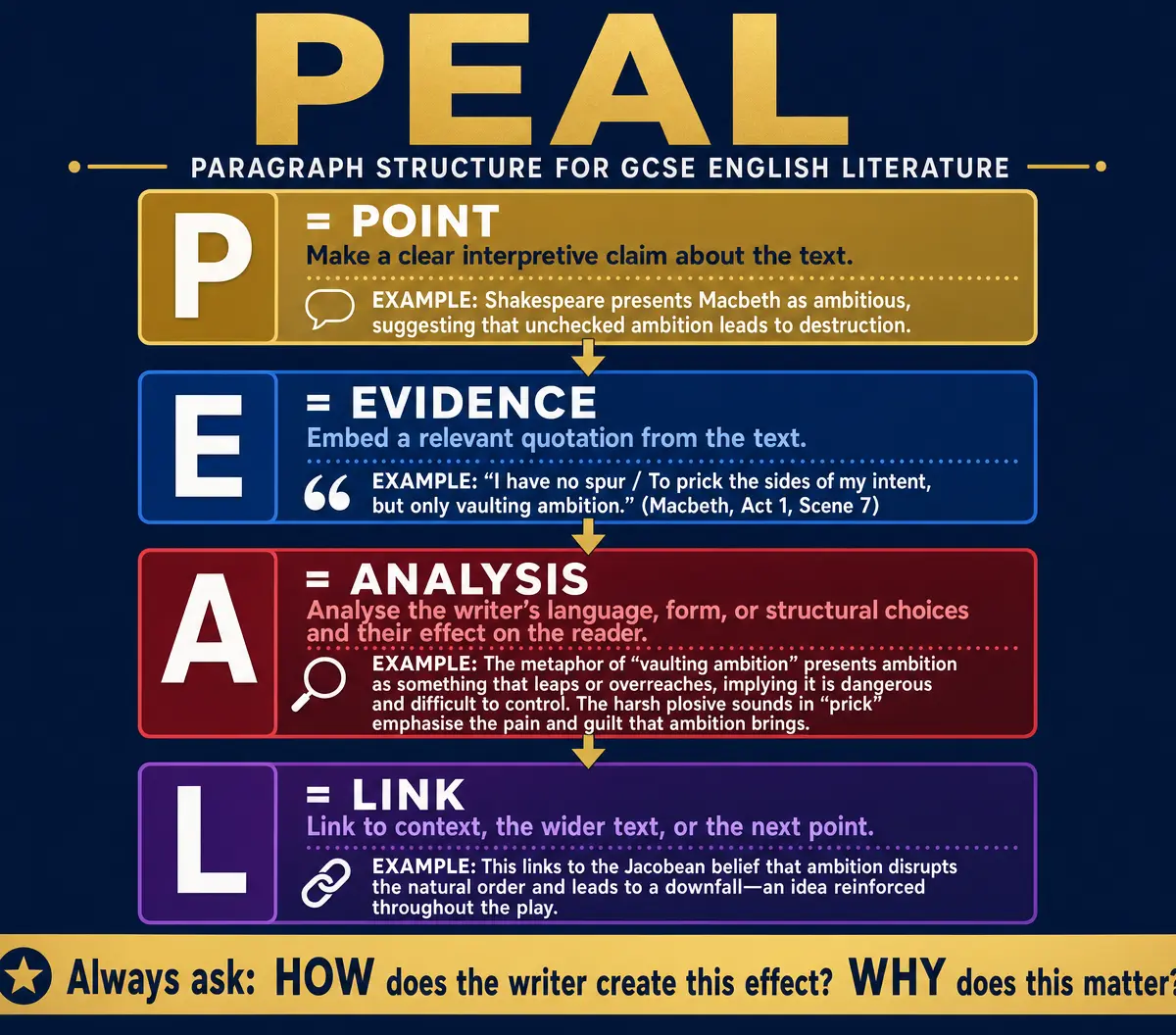
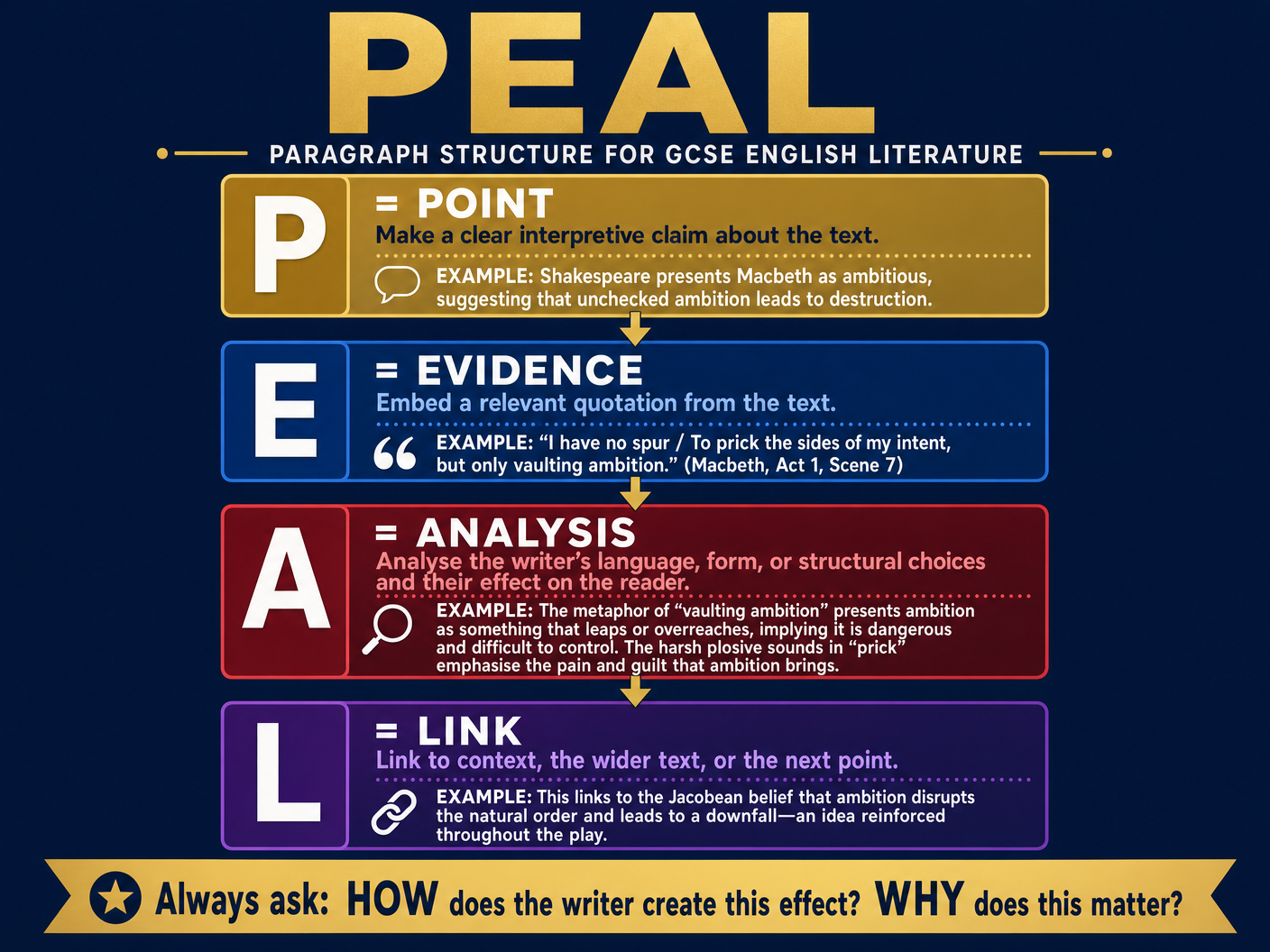
When writing your paragraphs, the PEAL structure (Point, Evidence, Analysis, Link) ensures you cover all necessary AOs. The 'Analysis' section must zoom in on specific words. For example, rather than just stating a character is angry, explore how the writer uses "harsh plosive consonants" or "fragmented syntax" to convey that anger.
Integrating Context (AO3 Focus)
Context must never be a 'bolt-on' history lesson at the end of a paragraph. It must be integrated into your analysis. For Shakespeare, consider the Great Chain of Being, the Divine Right of Kings, or Jacobean anxieties about the supernatural and gender roles. For Post-1914 texts, consider the impact of the World Wars, the rigid class system, the rise of socialism, or changing attitudes toward women. Always ask: How does this context illuminate the writer's purpose?
Visual Resources
3 diagrams and illustrations
Interactive Diagrams
1 interactive diagram to visualise key concepts
Conceptual Flow Outline
Optimal Exam Workflow for Component 1 Essays
Worked Examples
2 worked examples — open one to explore the question and available guidance.
Practice Questions
Test your understanding — click to reveal model answers
Section A: Starting with this extract, explore how Shakespeare presents the relationship between men and women. Write about how the relationship is presented in the extract, and how it is presented in the play as a whole.
Hint: Consider the power dynamics. Who holds the power in the extract? Does this shift later in the play? Link to Jacobean patriarchal society.
Section B: How does the writer use the setting to reflect the themes of the text? (30 marks + 4 AO4)
Hint: Think of the setting as a microcosm. How does the physical space represent the social divisions, isolation, or conflict within the text?
Section A: Starting with this extract, explore how Shakespeare presents the theme of guilt and conscience.
Hint: Look for physical manifestations of guilt (sleeplessness, visions, blood imagery). How does guilt affect the characters' language?
Section B: 'The younger generation offers the only hope for the future.' How far do you agree with this statement about the text? (30 marks + 4 AO4)
Hint: Compare the attitudes of the older and younger characters. Do the young characters change? Do they take responsibility?